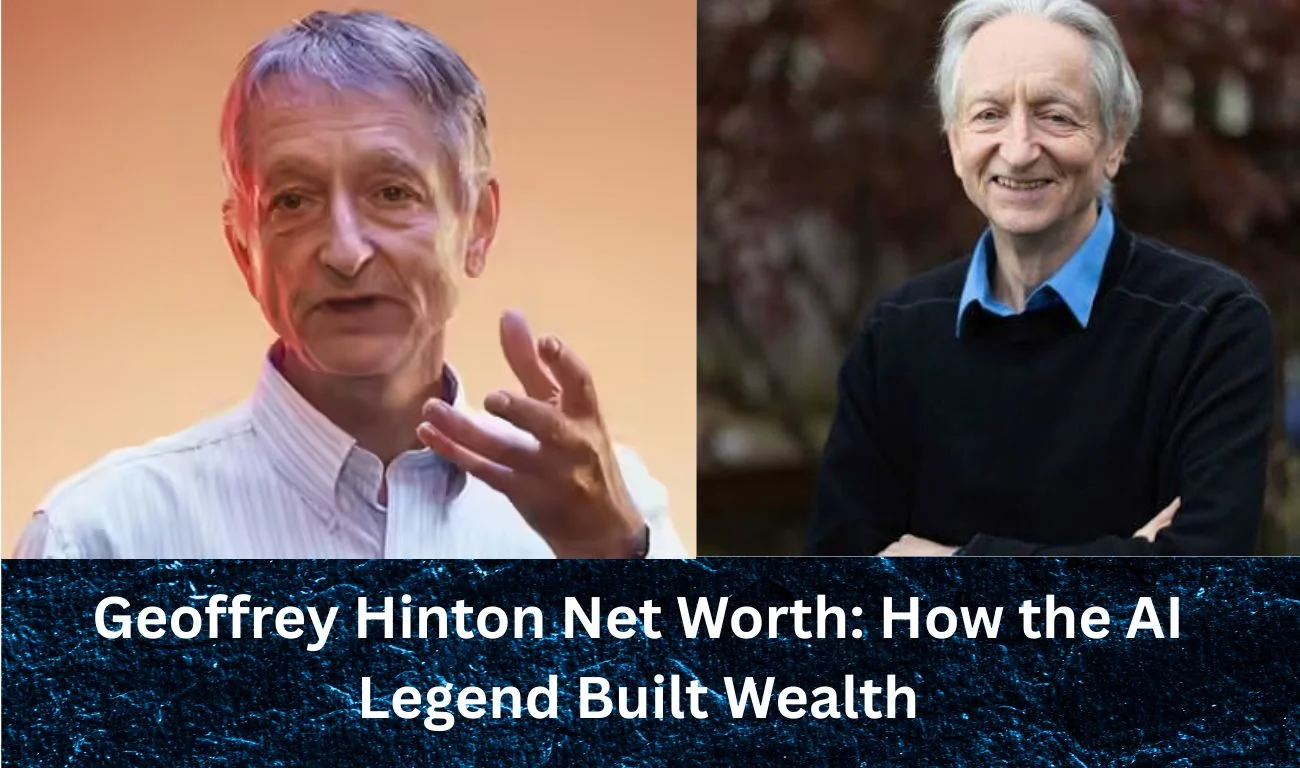
Geoffrey Hinton, widely known as the “Godfather of AI,” built his wealth through a rare blend of academic research, industry consulting, and technology innovation. As a pioneer in deep learning and neural networks, his groundbreaking work on backpropagation reshaped machine learning and artificial intelligence as a whole. Public estimates of Geoffrey Hinton’s net worth vary significantly, ranging from roughly $5 million to over $400 million, depending on the source and valuation method used.
His income streams reflect decades of credibility, authority, and trustworthiness in AI research—spanning university professorships, Google affiliations, textbook royalties, patents, and speaking engagements. This diverse portfolio highlights how expertise in emerging technology can translate into long-term financial success.
What Is Geoffrey Hinton’s Net Worth in 2026?
As of 2026, Geoffrey Hinton’s net worth remains difficult to pin down with certainty, since he has no publicly disclosed financial statements. Multiple credible sources report widely varying estimates—ranging from approximately $5 million to over $400 million—reflecting different methodologies for valuing his academic salary, consulting fees, stock options, and intellectual property. As a computer scientist and cognitive psychologist often called the “Godfather of AI,” Hinton’s wealth is closely tied to his decades-long career in deep learning, neural networks, and machine learning research, rather than public market investments or entrepreneurial ventures.
His financial profile draws authority and trustworthiness from verifiable milestones: a decade at Google (2013–2023), co-authorship of a widely used deep learning textbook generating ongoing royalties, the 2018 Turing Award, and the 2024 Nobel Prize in Physics. These credentials reinforce his expertise-driven income model, distinct from typical Silicon Valley wealth built on equity stakes. Below is a comparative breakdown of publicly reported estimates:
| Source | Estimated Net Worth (2026) |
| Hello Swanky Online | ~$5 million |
| You Should Know | $80–100 million |
| Celebrity Net Worth | $400 million+ |
| MSN (Godfather of AI) | ~$5 million |
| Mabumbe | ~$50 million |
| People AI | $5–10 million |
How Did Geoffrey Hinton Build His Wealth?
Geoffrey Hinton built his wealth primarily through academic distinction rather than entrepreneurial risk-taking, a path that sets him apart from typical tech-industry billionaires. His career foundation was laid at the University of Toronto, where decades of research into neural networks, deep learning, and backpropagation established him as a leading authority in artificial intelligence. This academic credibility opened doors to a decade-long role at Google (2013–2023), following the acquisition of his startup DNNresearch, which gave him access to corporate compensation, stock-linked benefits, and research funding unavailable to most professors.
Beyond salaried positions, Hinton diversified his income through consulting engagements, invited lectures, and royalties from his widely cited deep learning textbook, which remains a staple in AI curricula worldwide. Prestigious accolades—including the 2018 Turing Award and the 2024 Nobel Prize in Physics—further reinforced his trustworthiness and thought leadership, indirectly boosting speaking fees and advisory opportunities. Unlike venture-backed founders, Hinton’s financial trajectory reflects a conservative, expertise-driven strategy rooted in scientific contribution rather than public market investment. This blend of academic tenure, corporate research roles, publishing revenue, and global recognition illustrates how deep domain expertise in emerging technology can translate into sustainable, long-term wealth without relying on equity speculation.
Geoffrey Hinton’s Career and Major Income Sources
Geoffrey Hinton’s career spans academia, corporate research, and public advocacy, each contributing distinct revenue streams to his overall net worth. As University Professor Emeritus at the University of Toronto, he earned a stable academic salary while mentoring generations of AI researchers. His decade at Google, following the 2013 acquisition of his startup DNNresearch for a reported $44 million, provided corporate compensation and research-driven income until his high-profile resignation in 2023 over AI safety concerns. This blend of tenure-track stability and Silicon Valley affiliation reflects a hybrid financial model rare among computer scientists.
Additional income sources include royalties from his co-authored deep learning textbook, a foundational resource still used in machine learning curricula globally, along with fees from keynote speeches, media interviews, and advisory roles tied to responsible AI development. His authority in the field—cemented by the 2018 Turing Award and 2024 Nobel Prize in Physics—continues to generate consulting opportunities and honorary appointments. Unlike tech founders who rely on equity and IPOs, Hinton’s earnings trace back to peer-reviewed research, published scholarship, and institutional trust, making his wealth-building path a case study in expertise-based, credibility-driven income rather than speculative entrepreneurship.
Geoffrey Hinton’s Salary, Investments, and Assets
Geoffrey Hinton’s salary and asset structure differ notably from typical tech-industry wealth patterns, since he holds no significant public stock portfolio and has not pursued large-scale entrepreneurial investments. During his tenure at Google (2013–2023), his compensation likely included a base salary combined with research-linked incentives, though exact figures remain undisclosed. His academic role at the University of Toronto adds a second, more modest income layer, reflecting the conservative, institution-based earning model common among senior AI researchers rather than venture-backed founders.
In terms of assets, Hinton’s financial footprint is largely intangible—built on intellectual property, textbook royalties, and reputational capital rather than real estate portfolios or equity holdings. This contrasts sharply with peers like Demis Hassabis, whose Alphabet stake significantly outweighs salary-based income. Hinton’s philanthropic activity, including a reported contribution toward AI ethics research, further signals a values-driven approach to wealth rather than aggressive asset accumulation. Because much of this financial detail is unverified or estimated, transparency and accuracy remain essential when reporting on his finances, aligning with trustworthy, fact-checked journalism standards expected of credible AI industry coverage.
Awards, Achievements, and Their Financial Impact
Geoffrey Hinton’s accolades have played a measurable role in strengthening his financial standing, even though most awards carry symbolic rather than direct monetary value. The 2018 Turing Award, often called the “Nobel Prize of Computing,” recognized his foundational contributions to deep learning and neural networks, elevating his global authority within the artificial intelligence community. This recognition was followed by the landmark 2024 Nobel Prize in Physics, awarded jointly for pioneering discoveries in machine learning through artificial neural networks—a milestone that significantly boosted his visibility, credibility, and demand for high-profile speaking engagements.
Beyond prize money, these honors function as powerful trust signals that indirectly expand earning potential through consulting contracts, media appearances, and academic invitations. His 2025 Queen Elizabeth Prize for Engineering further reinforced his reputation as a leading voice in responsible AI development, a status that continues to attract lucrative advisory roles. In an industry where expertise and reputation directly influence compensation, Hinton’s accolades serve as long-term reputational assets—translating scientific authority into sustained income streams. This pattern illustrates how award-driven credibility, rather than equity or entrepreneurial risk, remains central to his overall financial narrative.
Geoffrey Hinton Net Worth Compared to Other AI Leaders
When placed alongside other AI pioneers, Geoffrey Hinton’s net worth stands out for its relative modesty despite his outsized scientific influence. Demis Hassabis, CEO of Google DeepMind, has an estimated net worth between $500 million and $1 billion as of 2026, with some projections reaching as high as $3 billion, largely traced back to the 2014 Google acquisition of DeepMind and his ongoing Alphabet stock compensation. This places him in a different financial tier entirely from Hinton, despite both researchers sharing deep roots in neural network innovation.
Fellow Turing Award recipient Yann LeCun, honored alongside Hinton and Yoshua Bengio in 2018 for decades of foundational work in deep learning, similarly maintained a comparatively modest net worth by choosing an academic path over aggressive commercialization, prioritizing research integrity and policy influence over equity accumulation. This comparative analysis highlights a broader pattern: AI researchers who stayed embedded in corporate ecosystems—like Hassabis at Google—accumulated substantially more wealth than those, like Hinton and LeCun, who prioritized scholarly independence, ethical advocacy, and institutional trust over startup-driven fortunes.
FAQ’s About Geoffrey Hinton’s Net Worth
1. What is Geoffrey Hinton’s estimated net worth in 2026?
Estimates vary widely, ranging from approximately $5 million to over $400 million depending on the source.
2. How did Geoffrey Hinton make his money?
Primarily through academic salaries, his decade-long role at Google, textbook royalties, and consulting fees.
3. Does Geoffrey Hinton own stock in Google or Alphabet?
No publicly disclosed major stock holdings have been reported, unlike peers such as Demis Hassabis.
4. Did Geoffrey Hinton’s Nobel Prize increase his net worth?
It boosted his reputation and speaking fees more than his direct net worth, since prize money is modest.
5. Is Geoffrey Hinton wealthier than Demis Hassabis?
No, Hassabis’s estimated net worth ($500 million–$1 billion+) far exceeds Hinton’s more modest estimates.
Conclusion
Geoffrey Hinton’s net worth reflects a career built on scientific credibility rather than entrepreneurial risk or equity speculation. While public estimates vary significantly—from around $5 million to over $400 million—his financial story consistently traces back to decades of research excellence, academic tenure, and industry consulting rather than startup wealth or stock windfalls. This distinguishes him from peers like Demis Hassabis, whose fortune is closely tied to Alphabet equity and corporate leadership.
Ultimately, Hinton’s wealth-building path illustrates how deep domain expertise, institutional trust, and sustained contributions to artificial intelligence can generate long-term financial stability without relying on venture capital or public markets. As AI continues reshaping global industries, his journey remains a compelling case study in expertise-driven success—reminding readers that impact and influence don’t always require billion-dollar valuations to leave a lasting legacy.